In this article
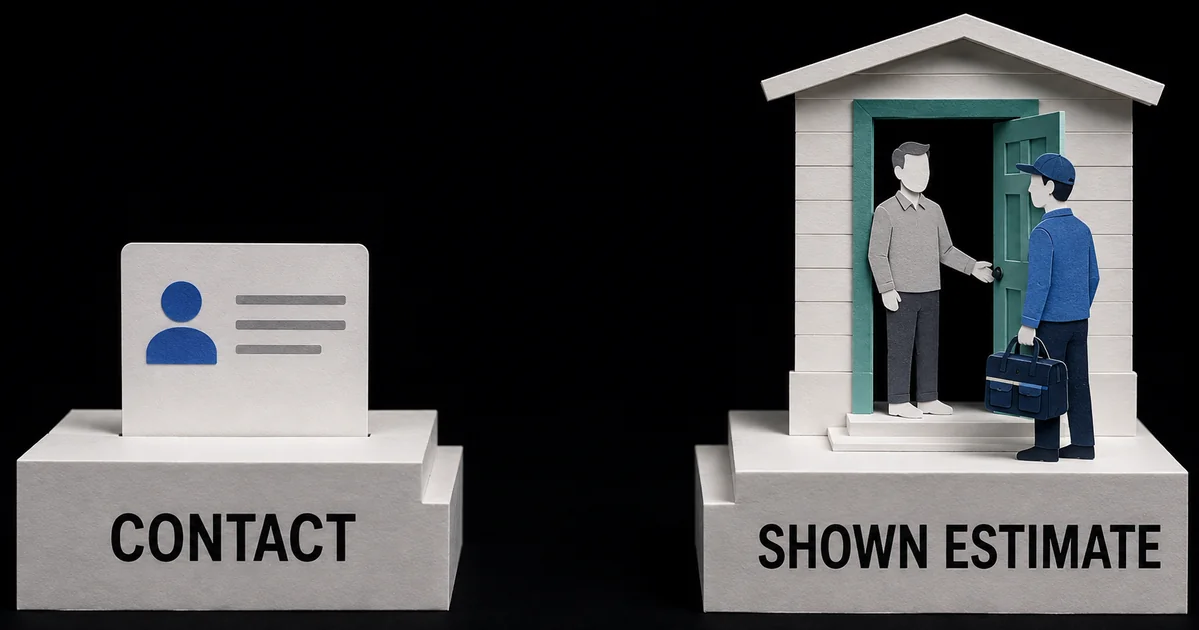
A lead is a contact record. An appointment is a homeowner who agreed to a time. A shown appointment is that homeowner at the estimate. Every marketing vendor bills you at one of those points, and the point they pick tells you what they're paid to do. Once you know where the bill lands, a $60 lead and an appointment that costs several times more stop looking like two prices for one thing. They're two different products.
What a bought lead looks like
Here's an example of a lead the way it shows up in a contractor's inbox. It's made up, not pulled from any platform, but the fields are the ones these records carry.
- Service requested
- Central AC replacement
- Name
- M. Alvarez
- Phone
- (one number)
- ZIP
- 30044
- Received
- Tuesday, 2:14 PM
- Fee
- charged to your card
What's not on the record matters more than what is. In this example, nobody has talked to M. Alvarez yet. Nobody knows if they own the house, if the system is dead or just old, if they want a price this week or next spring, or if their spouse has to be in the room. And on a shared-lead platform, you may not be the only one holding this card. Angi's own FAQ says a homeowner's request is matched with up to five pros, that leads are "not guaranteed jobs," that you should "follow up quickly with the homeowner to maximize your chances," and that you're charged for a lead whether or not you open or respond to it.
So the product is not a customer. It's a phone number and a head start that up to four other shops may have gotten at the same time. Everything that turns it into a homeowner on your calendar still has to happen, and somebody has to do it.
A lead is the start of the work. An appointment is the end of it. That's the whole difference, and it's the reason the prices aren't comparable.
The five stops between a form fill and a sale
Every HVAC replacement job that came from marketing passed through the same five stops. Here's what happens at each one, who does the work when you buy leads, who does it under our pay-per-appointment model, and where the bill lands under each of those two offers.
| Stop | What happened | Buying leads: who does the work | Local Leap Media PPA: who does the work | Where the bill lands (leads vs our PPA) |
|---|---|---|---|---|
| 1. Inquiry | A homeowner filled out a form or called. | The platform or agency ran the ad. | We run the ad, on our ad spend. | Lead vendors bill here: per lead. Our PPA does not. |
| 2. Qualified contact | Someone reached the homeowner and confirmed the project fits. | Your office. Every dial, voicemail, and callback. | Our setters. | Neither offer bills here. |
| 3. Booked | The homeowner agreed to a day and time for an in-home estimate. | Your office. | Our setters, straight onto your calendar. | Neither offer bills here. Some other "appointment" vendors do; ask. |
| 4. Shown | The estimate actually happened. | Your comfort advisor. | Your comfort advisor. | Our PPA bills here: one flat fee per shown appointment. Lead vendors already billed at Stop 1. |
| 5. Sale | The homeowner signed. | You. | You. | Neither offer bills here. The job is yours. |
Read the last column top to bottom. That's the article.
Stop 1: the inquiry
This is the part every vendor is good at. Ads work. Forms fill. A lead vendor's job is done at this stop, which is why this is where the bill lands. Whatever the record turns into afterward is your problem by design.
Stop 2: the qualified contact
This is where most of the work lives, and it's the stop that gets skipped in the pitch. My view: nobody should be billing you here, because it's all cost and no result yet.
Somebody has to call M. Alvarez. Probably more than once. Somebody has to find out if they own the home, if it's a replacement or a $200 repair they'll describe as "the AC is acting up," if both decision-makers can be there, and if they're shopping a price for this month or for "someday." An HVAC office manager can do that in a five-minute call when the homeowner picks up. The problem is the ones who don't.
Run a small example with your own inputs. Say you bought 100 leads this month. Say 65 of them go nowhere: no answer, wrong number, renter, repair, already bought. If each one takes your office five to eight minutes of dialing and notes, that's roughly five and a half to nine hours of phone time that produced nothing. That's one attempt each. Add second and third tries and the hours climb, and the time is coming off a person you're already paying to do something else.
That's the cost that never shows up on the lead invoice. It looks free because the office manager was already on payroll. It isn't free. It's the reason the $60 lead was never really $60.
Under pay-per-appointment, that's our setters' job. They make the call, they make it fast, because the homeowner is one click from another quote, and they ask the qualifying questions before anything touches your calendar. If M. Alvarez turns out to be a renter with a thermostat problem, you never hear about it and you never pay for it.
Stop 3: the booking
A booking is a real commitment: a day, a time, your name, and a confirmation in the homeowner's hand. It is not "yeah, call me next week." Vendors who sell "appointments" sometimes bill at this stop, which is worth knowing, because a booked appointment is not a shown one. Homeowners cancel. Life happens. If a vendor bills at the booking, the no-show is yours.
We book onto your calendar, run the reminders, and do not bill at this stop.
Stop 4: the shown estimate
The homeowner is home. The system is in front of your comfort advisor. This is the stop we bill at, and it's the only recurring one. Launching the account carries a one-time setup fee; after that, the only charge is one flat fee per shown, qualified appointment. Before launch we write down what "qualified" and "shown" mean for your account, and every charge matches that definition. A homeowner who doesn't show is not a charge.
The floor on your side is a homeowner at the estimate. There is no lower thing you can be billed for. Under bought leads, your worst month is the full lead bill plus a phone log. Under this, a month with no shown appointments is a month with no appointment fees.
Stop 5: the sale
This one's yours, and it should be. Your price, your financing, your comfort advisor's skill in the living room. A shown appointment can still walk. Some homeowners take your number to shop it. That's the one boundary worth saying plainly: we sell the estimate, not the signature. What we take off your plate is stops one through three, all of the calling, and the risk that any of it fails.
If you want the cost-per-closed-job math across all three models, the Real Math piece runs it on equal terms. This piece is about the units. That one's about the dollars.
Why "better leads" was never the right claim
Every contractor who's bought marketing has heard "our leads are higher quality." It's the most common line in the category and the hardest to check. In 2023 the FTC finalized an order against HomeAdvisor over exactly that kind of claim: it alleged the company told contractors its leads were people "ready to hire a service provider" when it couldn't back that up, and the order required HomeAdvisor to pay up to $7.2 million. One company, one case, three years ago. But it's a good example of why a quality claim you can't test is just a pitch.
Pay-per-appointment doesn't ask you to believe a quality claim. It moves the bill to a stop you can see with your own eyes. The homeowner either sat down with your comfort advisor or they didn't. You don't need our word for it. You have your calendar.
And the campaign is yours. We run it under your name, in your territory, and we don't resell the homeowners it produces to anyone else. That doesn't stop a homeowner from calling a second company on their own. It does mean nobody is selling your inquiry to other shops while your office manager is still dialing.
What flips under pay-per-appointment isn't the quality of the lead. It's who's holding the risk at every stop before the doorbell.
Five questions to run on any vendor's pitch
Whatever you're being sold, leads, appointments, or a monthly retainer, the HVAC leads vs appointments question is really one question: which stop does the bill land on, and who does the work in between? These five get you the answer.
- Which stop triggers the charge? Inquiry, contact, booking, shown estimate, or sale. Make them point to it. The further right on the table, the more the vendor's paycheck depends on your calendar.
- Is the same homeowner going to anyone else? If yes, you're buying a head start, not a customer. Price it that way.
- Who makes the calls, and who eats the ones that go nowhere? If the answer is "your office," stop two is yours, and so is its cost.
- What exactly counts as a qualified, shown appointment, in writing? Homeowner, replacement, both decision-makers, showed up. If the definition lives in a sales rep's head, it will change on invoice three.
- What do I pay in a month where nothing shows? The honest pay-per-appointment answer is nothing for appointments. Any other answer tells you who's really carrying the risk.
If you want to run those five on us, book a 15-minute growth call. Bring last month's lead invoice and your call log. We'll mark up which stop you paid at and what the rest cost you. No pitch, just the pipeline.